Industrial Gelatin Market Insights 2026: Trends, Applications & Sourcing Guide
Industry Insight · 2026
Industrial Gelatin Market Insights 2026: Trends, Applications & Sourcing Guide
A buyer's briefing on industrial gelatin (animal glue): where the market is heading, how it differs from food and pharma grades, what it's actually used for, and how to source it without surprises.
Industrial gelatin — often called animal glue — is one of the oldest bonding and structuring materials still in large-scale use. Far from being a legacy product, demand is quietly reshaping around sustainability, traditional manufacturing, and specialized industrial niches. This briefing covers what buyers and formulators need to know in 2026.
1. What Is Industrial Gelatin?
Industrial gelatin is a protein colloid derived from animal by-products — primarily bovine bone and skin, and porcine skin — through controlled hydrolysis. Unlike edible or pharmaceutical grades, it is produced and specified for non-food use: adhesion, sizing, coating, and gelling in manufacturing processes.
Its defining commercial property is the Bloom value (gel strength), which for industrial grades typically spans 40–300 Bloom. Lower Bloom grades flow and wet easily for tips and sizing; higher Bloom grades deliver stronger films and bonds for structural adhesives.

2. The 2026 Market Landscape
Several forces are keeping industrial gelatin relevant even as synthetic polymers expand:
- Bio-based substitution. Manufacturers seeking renewable, biodegradable adhesives are revisiting animal glue for woodworking, bookbinding, and packaging — where it competes favorably on cure behavior and reversibility.
- Resilient traditional segments. Matches, jigsaw puzzles, abrasive cloth (emery/sandpaper backing), and photo/print processes still depend on gelatin's unique wetting and film-forming traits.
- Specialty recreation. Paintball shells and certain confectionery-adjacent novelty items use gelatin films that dissolve or rupture predictably.
- Circular feedstock. Industrial gelatin shares its raw-material stream with food and pharmaceutical gelatin, turning meat-industry by-products into value rather than waste.
Industry observers describe the global animal-glue / industrial-gelatin segment as a steady, low-to-mid single-digit CAGR market — not explosive, but stable and structurally defended by performance niches synthetics struggle to replace.

3. Industrial vs. Food & Pharmaceutical Gelatin
The confusion buyers most often face is assuming "gelatin is gelatin." The grades are deliberately different:
| Dimension | Industrial Gelatin | Food / Pharma Gelatin |
|---|---|---|
| Intended use | Adhesion, sizing, coating, non-edible | Edible / encapsulating / medical |
| Microbiological limits | Relaxed vs. food spec | Strict (ISO 22000, FDA, HALAL) |
| Bloom range | 40–300 (broad) | 80–300 (application-tuned) |
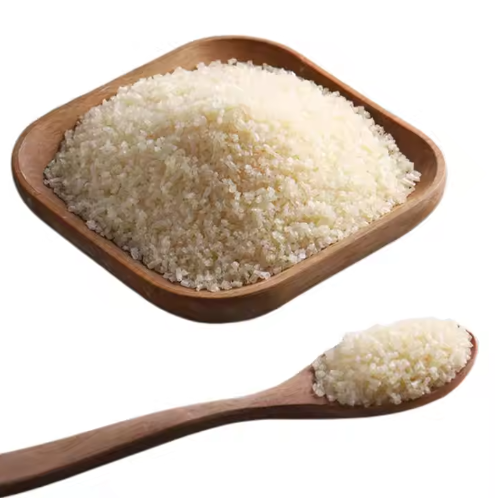
| Typical form | Granule, powder, crushed capsule, glue stick | Powder, sheet, capsule shell |
| Price posture | Cost-driven, bulk | Spec-driven, certified |
Rule of thumb: never substitute industrial gelatin into a food or pharmaceutical line. The certifications and microbiological controls simply are not there.
4. Core Application Sectors
Industrial gelatin's value shows up wherever a natural, reversible, and tunable bond or film is needed:
- Matches. Gelatin binds the match-head composition and provides the controlled burn matrix. Crushed recycled capsules are a common, cost-effective feedstock here.
- Woodworking & joinery. Hot animal glue remains the preferred choice for antique restoration and fine furniture because it is strong yet reversible.
- Papermaking & bookbinding. Used for surface sizing, calender coating, and as a traditional book-binding adhesive.
- Textile sizing & printing. Improves weave stiffness and print definition.
- Abrasive cloth & sandpaper. Bonds grit to backing with a flexible, conformable film.
- Paintball & novelty shells. Gelatin films rupture on impact with predictable energy.
- Jigsaw puzzles & photo/print. Coating and lamination layers.
- Metal refining & electroplating. As an auxiliary binder and sizing agent in process media.
- Medical gauze & bandage. Stiffening and coating for absorbent dressings.

5. Raw Materials & Sustainability
Industrial gelatin is a poster child for circular manufacturing. Its feedstock — bone and hide trim — is a by-product of the meat industry that would otherwise be discarded. Converting it into a functional adhesive keeps value in the system and reduces reliance on petrochemical polymers in applications where a bio-based bond performs as well or better.
For buyers with ESG or clean-label commitments in adjacent product lines, animal glue is a defensible, renewable choice.
6. Key Quality Parameters
When specifying industrial gelatin, the parameters that actually move your process are:
| Parameter | Why it matters | Typical industrial range |
|---|---|---|
| Bloom (gel strength) | Bond/film strength | 40–300 g |
| Viscosity | Spreadability, penetration | Tuned per grade |
| Moisture | Shelf life, handling | ~11–13% |
| Mesh / particle size | Dissolution speed | 8–60 mesh selectable |
| pH | Compatibility with process chemistry | 5.0–7.0 |
7. How to Select the Right Grade
- Matches & tips: lower Bloom (40–120) for fast wetting and easy bonding.
- Woodworking / bookbinding: mid Bloom (120–200) hot glue for reversible, strong joints.
- Abrasive cloth / sandpaper: mid-high Bloom for a tough, flexible grit film.
- Coating / sizing / textile: select by viscosity and mesh, not just Bloom.
- Crushed capsule feedstock: choose recycled capsule grade for cost-sensitive match and adhesive lines.
If your application is unusual, send the target process and we will map a grade rather than forcing a catalog number.
8. Why Source from Xiamen Huaxuan Gelatin
Xiamen Huaxuan Gelatin Co., Ltd. has 20 years of export experience and runs its own plant in Xiamen, China — direct from manufacturer, no middlemen. For industrial buyers the practical advantages are:
- Full Bloom coverage (40–300) across animal glue, crushed capsules, and jelly-glue stick forms.
- Stable batch quality backed by the same process discipline used for certified food lines.
- Complete export documentation — COA, certificate of origin, and customs paperwork for smooth clearance to ports worldwide (FOB Xiamen, CIF available).
- Flexible MOQ & sampling so you can validate a grade before committing volume.

9. Frequently Asked Questions
Q1: What is industrial gelatin and how is it different from food grade?
Industrial gelatin (animal glue) is specified for non-food uses — adhesion, sizing, coating. It is not held to food/pharma microbiological or certification standards, so it must never enter edible or medical products.
Q2: What Bloom strength should I choose for my application?
Lower Bloom (40–120) suits matches and fast-wetting tips; mid Bloom (120–200) suits woodworking and bookbinding; mid-high Bloom works for abrasive cloth and coatings. Viscosity and mesh matter as much as Bloom for sizing and textile use.
Q3: Is industrial gelatin environmentally friendly?
Yes — it is bio-based and biodegradable, made from meat-industry by-products. For applications where a renewable bond performs as well as synthetics, animal glue is a circular, defensible choice.
Q4: What are crushed gelatin capsules used for?
Recycled crushed capsules are a cost-effective industrial feedstock, mainly for match-head composition and general industrial adhesives.
Q5: Can Huaxuan supply industrial gelatin with export documentation?
Yes. We provide COA, certificate of origin, and full customs documentation, with shipment from Xiamen port under FOB or CIF terms and flexible MOQ plus sampling.
10. Talk to Our Team
Whether you need a standard animal-glue grade or a tuned specification for a niche process, we can supply and document it. Reach us directly:
Lily — Xiamen Huaxuan Gelatin Co., Ltd.
Email: lily@hx-gelatin.com
Mobile / WhatsApp: +86 17750005106
Web: hx-gelatin.com
Gelatin in 2026: Market Outlook, Production Process & Application Guide for B2B Buyers
Instant gelatin