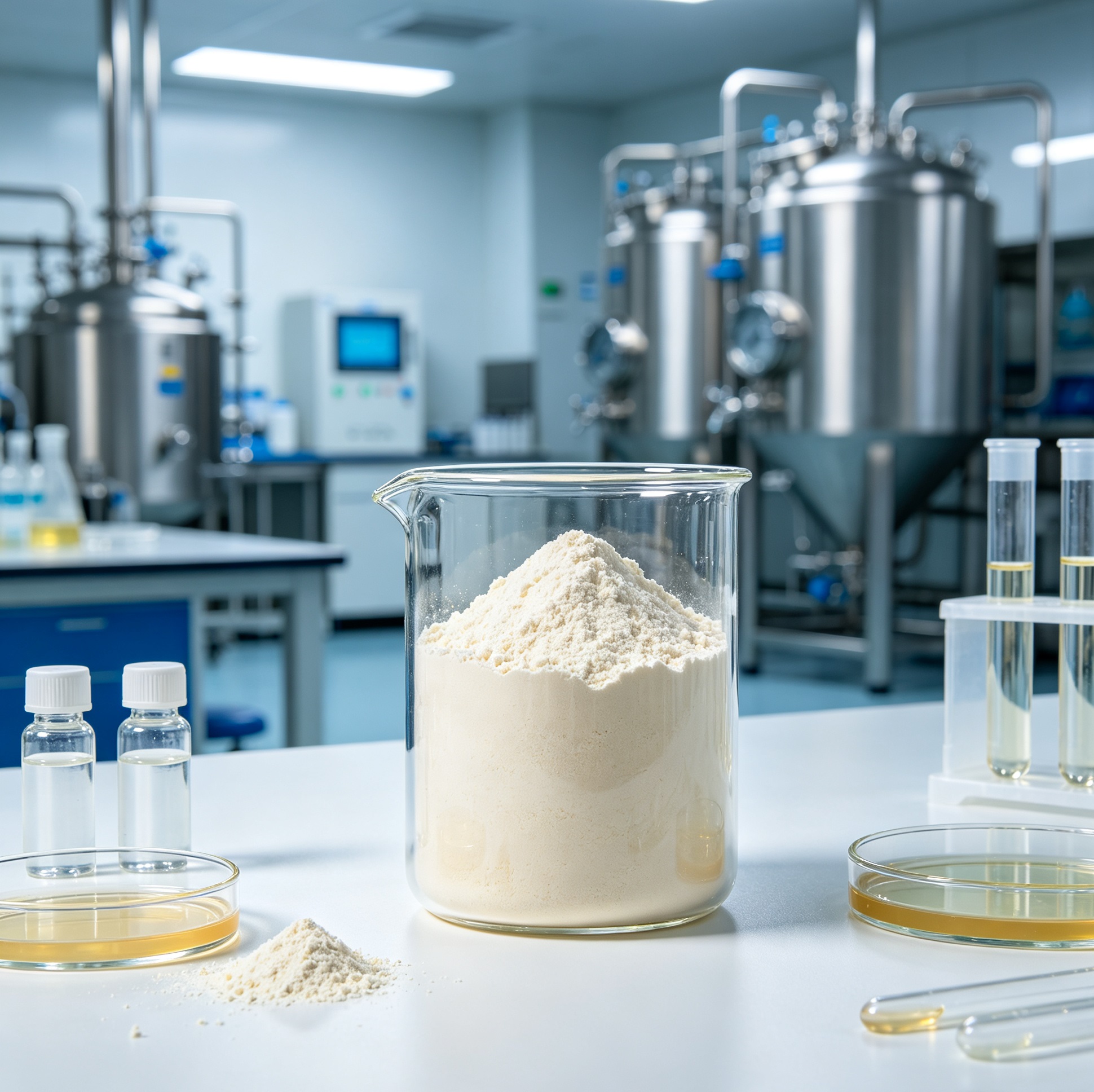
Peptone for Enzyme Fermentation: How Your Nitrogen Source Decides Enzyme Yield
Peptone for Enzyme Fermentation: How Your Nitrogen Source Decides Enzyme Yield
Enzymes are proteins — and proteins need nitrogen. Here is why peptone is the nitrogen source of choice for enzyme preparation, and how to use it right.

If you manufacture industrial enzymes — proteases, amylases, cellulases, xylanases, lipases or phytases — you already know the medium formula is half the battle. Carbon source gets the attention, but the nitrogen source is what actually builds microbial biomass and the enzyme proteins you are trying to harvest. This article explains why peptone earns its place in enzyme fermentation, how it compares with other nitrogen sources, which quality parameters matter, and how to dose it for maximum titre.
1. What peptone actually is
Peptone is a water-soluble protein hydrolysate — most commonly produced by the controlled enzymatic or acid hydrolysis of animal (bovine bone/skin) or plant protein. The hydrolysis breaks native proteins into a mixture of:
- Short peptides (di- to oligo-peptides) that microbes take up directly;
- Free amino acids ready for protein synthesis;
- Growth factors, vitamins and minerals carried over from the source material.
That blend is exactly what a growing, enzyme-secreting culture wants: readily assimilable organic nitrogen plus the micronutrients that keep metabolism humming. Huaxuan's industrial bovine peptone is derived from bovine bone collagen through controlled hydrolysis, giving a stable amino-acid profile and reliable batch-to-batch quality for fermentation and culture-media use.
2. Why enzyme fermentation needs peptone
Industrial enzymes are themselves proteins. To produce them, the production strain must first build biomass, then redirect resources into synthesising and secreting the target enzyme. Both phases are nitrogen-hungry:
- Growth phase — cells need amino acids to replicate ribosomes, enzymes and cell walls.
- Production phase — extracellular enzyme synthesis is a massive protein-translation load that drains the amino-acid pool fast.
Inorganic nitrogen (e.g. ammonium salts) can supply elemental N, but the cell must spend energy converting it into amino acids. Peptone shortcuts that step: it delivers peptides and free amino acids the cell can use immediately, so more energy goes into growth and enzyme output. It also buffers the medium and supplies trace nutrients that simple salts cannot.
Bottom line: a good peptone raises both specific growth rate and final enzyme titre — which is why it shows up in seed cultures and production media alike.
3. How peptone works through the fermentation run
Peptone earns its keep at three points in a typical enzyme campaign. The diagram below shows where organic nitrogen enters the process:
Figure 2 — Where peptone enters an enzyme fermentation campaign.
In the seed stage, peptone accelerates culture build-up so you pitch a vigorous, uniform inoculum. In the production stage, it sustains the high translational demand of enzyme secretion and helps maintain cell viability deep into the run. Skimp on nitrogen early and you pay for it in a slow, low-titre fermentation later.
4. Peptone vs other nitrogen sources
Peptone is rarely the only option. Here is how it stacks up against the common alternatives in enzyme media:
| Nitrogen source | Amino-acid / peptide profile | Batch consistency | Typical cost | Best fit |
|---|---|---|---|---|
| Peptone (animal/plant hydrolysate) | Rich, broad mix of peptides + free AA + growth factors | High (with a controlled source) | Moderate | Seed & production media where yield matters |
| Yeast extract | Rich in B-vitamins, nucleotides; low peptides | High | Higher | Vitamin-limited strains, premium media |
| Corn steep liquor (CSL) | Good AA + lactic acid; variable | Variable (seasonal) | Low | Cost-driven bulk enzyme (e.g. some glucoamylases) |
| Soybean meal / defatted | Good protein, slow hydrolysis | Moderate | Low | Solid-state fermentation, crude media |
| Ammonium salts (NH₄)₂SO₄ | None (inorganic N only) | Very high | Very low | Supplement / cost reduction, not sole source |
In practice, many enzyme producers blend peptone with a cheaper bulk nitrogen source (CSL or ammonium) to balance cost against the peptide-driven growth boost peptone provides. Peptone's edge is consistency and speed — it removes the "will this batch perform?" variable from your medium.
5. Key quality specs for enzyme-grade peptone
Not all peptone is created equal. For enzyme fermentation you want a product with a stable amino-acid profile, high solubility and tight impurity limits. Representative specifications for Huaxuan industrial bovine peptone:
| Parameter | Typical specification | Why it matters for fermentation |
|---|---|---|
| Appearance | Light yellow powder | Consistent source material & processing |
| Moisture | ≤ 6% | Prevents caking, protects solubility & shelf life |
| Solubility (in water) | ≥ 98% | Fully available nitrogen; no insoluble loss |
| pH (1% solution) | 4.0 – 6.0 | Predictable medium buffering |
| Total nitrogen | ≥ 14% | Measures usable protein content |
| Amino nitrogen | ≥ 3% | Indicates free AA / small peptides (fast uptake) |
| Arsenic (As) | ≤ 5 ppm | Heavy-metal safety for export & food/pharma use |
| Lead (Pb) | ≤ 10 ppm | Heavy-metal limit |
| Total plate count | Controlled, low | Avoids contaminating the medium |
| Pathogens | Negative | Salmonella / E. coli absent |
Always request a Certificate of Analysis (COA) per lot and confirm the amino-nitrogen figure — it is the single best proxy for how "ready-to-use" the nitrogen in that batch really is.
6. Peptone across enzyme types
Peptone supports a wide range of industrial enzyme productions:
- Proteases (subtilisin, alkaline/neutral protease) — peptone supplies the amino acids the producing strain needs to over-produce secreted proteases.
- Amylases & glucoamylases — peptone in the seed stage ensures a vigorous inoculum for starch-processing enzyme campaigns.
- Cellulases & xylanases — common in feed and biofuel; peptone maintains producer viability through long, inducible runs.
- Lipases — peptone-based media improve both biomass and extracellular lipase titre.
- Phytases — widely used in animal feed; consistent peptone quality protects batch-to-batch enzyme activity.

7. Dosing & best practices
Start with the standard range
A typical addition is 0.5% – 2.0% (w/v) peptone in the medium, often combined with a carbon source (glucose, sucrose, starch or corn steep solids). When peptone is the sole organic nitrogen source, lean toward the higher end.
Screen before you scale
- Run a small shake-flask or mini-bioreactor matrix across 0.5% / 1.0% / 1.5% / 2.0% peptone.
- Measure biomass (OD) and final enzyme activity — not just growth.
- Lock in the lowest dose that still hits your titre target to control cost.
Sterilisation & handling
- For heat-labile fractions, consider separate (e.g. filter) sterilization of the peptone solution, or add post-autoclave.
- Use consistent lot numbers across a campaign to avoid medium reformulation mid-run.
- Store sealed in a cool, dry, well-ventilated place — reseal promptly after each use to protect solubility.
Pro tip: pair peptone with yeast extract at a low ratio (e.g. 3:1 peptone:yeast) when your strain is vitamin-limited — you get the peptide boost of peptone with the B-vitamin top-up of yeast, usually cheaper than yeast alone.
8. Why Huaxuan bovine peptone
Xiamen Huaxuan Gelatin Co., Ltd. has 20 years of export experience supplying gelatin, collagen and protein hydrolysates to customers worldwide. Our industrial bovine peptone is built for fermentation and culture-media use:
- Stable amino-acid profile — controlled hydrolysis of bovine bone collagen.
- Reliable batch-to-batch quality — documented COA with every lot.
- Bulk supply capacity — steady volumes for industrial enzyme campaigns.
- Export-ready documentation — COA, MSDS, certificate of origin; HALAL certification available on request.

9. Frequently asked questions
What is the difference between peptone and tryptone?
Both are protein hydrolysates used in microbial media. Peptone is produced by enzymatic or acid hydrolysis of animal or plant protein and contains a broad mix of peptides, free amino acids, vitamins and minerals. Tryptone is a specific pancreatic digest of casein, valued for its high tryptophan content and consistent profile. Peptone is the more versatile, cost-effective bulk nitrogen source for enzyme fermentation; tryptone is typically reserved for selective or diagnostic media.
Can peptone be used for industrial-scale enzyme production?
Yes. Industrial enzyme manufacturers routinely use peptone in seed cultures and sometimes in production media. For large-scale runs, choose a supplier with consistent amino-acid profiles and reliable batch-to-batch quality, and confirm heavy-metal and microbial limits meet your process and regulatory requirements. Bulk supply capacity is essential to avoid medium reformulation between campaigns.
How much peptone should I add to an enzyme fermentation medium?
Typical addition is 0.5%–2.0% (w/v) of peptone in the medium, often combined with a carbon source such as glucose, starch or corn steep solids. The optimal level depends on the strain, target enzyme and whether peptone is the sole organic nitrogen source. Run a small shake-flask screen to lock in the dose that maximizes enzyme titre before scaling up.
Is bovine peptone suitable for halal and export markets?
Bovine-derived peptone can be supplied with HALAL certification and full export documentation (COA, MSDS, certificate of origin). When sourcing for halal or kosher markets, confirm the certification scope with your supplier and request the relevant certificates with each shipment.
How should peptone be stored?
Store peptone in a cool, dry, well-ventilated place, sealed in its original bag to prevent moisture uptake and caking. Keep away from strong odors and direct sunlight. Under these conditions, shelf life is typically 24 months. Reseal promptly after each use to maintain solubility and batch consistency.
Need a consistent peptone supply for your enzyme line?
Tell us your strain, target enzyme and medium formula — we'll recommend a peptone grade and lot spec that fits your process, with full export documentation.
📧 lily@hx-gelatin.com · 📞 +86 177 5000 5106
View peptone product page →Industrial Peptone: What B2B Buyers Should Know BeforeSourcing
Premium Peptone & Protein Hydrolysate for Industrial Applications